On this page
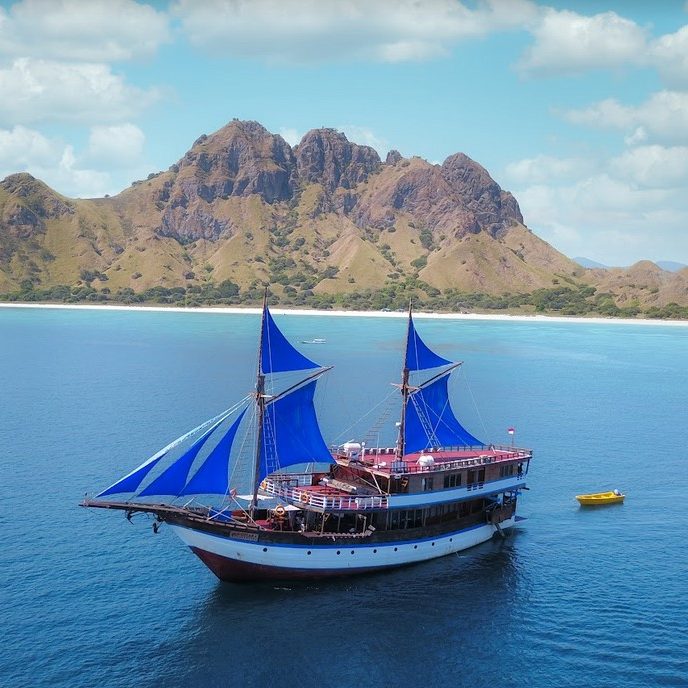
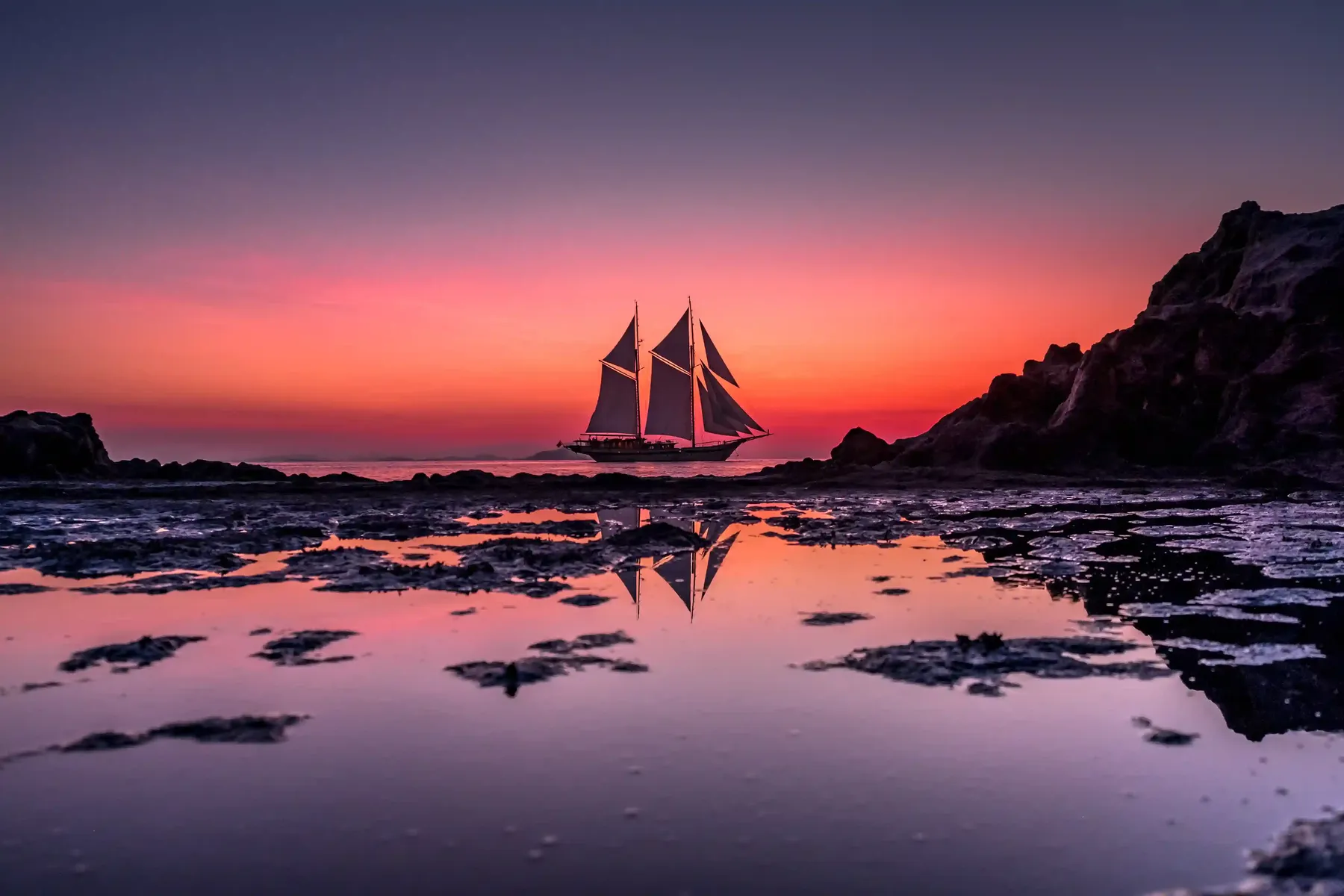
A standard 3D2N Komodo cruise anchors at Kalong on night one, runs three to four hours overnight to Padar, then anchors in a sheltered bay near Manta Point — usually Siaba Besar — on night two. At anchor it is quiet; the loud period is the single overnight passage.
Where the boat actually spends the night
Nobody markets anchorages, which is odd, because on a three-day cruise you spend more hours at anchor than at any single island. Here is where a Komodo cruise sleeps and why each spot is chosen.
| Night | Primary anchorage | Why there | Alternates |
|---|---|---|---|
| Night 1 (3D2N) | Kalong | The flying-fox exodus happens at dusk over the anchorage; sheltered mangrove bay | Sebayur, Kanawa if wind is wrong |
| Overnight passage | Under way, Kalong → Padar | 3–4 hours; the only way to be off Padar before first light | — |
| Night 2 (3D2N) | Siaba Besar | Sheltered bay near the Manta Point cluster; flat water, easy morning snorkel | Sebayur, Kanawa |
| Night 3 (4D3N) | Southern bay or Sebayur | Depends on whether the itinerary ran south; southern bays are near-empty | Northern shelter if swell is up |
Anchorage choice is made by the captain on the day against wind, swell and how many boats are already in the bay. Treat this as the normal pattern, not a fixed schedule. Evening-stop detail is on the Kalong, Kanawa and Sebayur evening stops page.
How quiet is it, really
Three distinct sound environments over a night, and they are not the same:
At anchor, engine off. You hear the generator as a low constant, the air conditioning in the cabin, and water moving along the hull. Most guests describe it as easier to sleep in than a hotel on a main road. There is no wave slap in a properly chosen anchorage because the bay is sheltered — that is the entire point of choosing it.
Under way, overnight passage. The Mitsubishi 6D22 is running at cruising load for three to four hours. Lower-deck cabins are closest to it. This is the loudest period of the trip and it is unavoidable, because it is the passage that delivers the Padar sunrise.
Pre-dawn. Anchor down off Padar, engine off, crew moving on deck preparing the tender. Then the wake-up, which in November is at about 04:26 to be on the ridge before a 05:31 sunrise.
Choosing a cabin for sleep, not for the photo
| Cabin | Deck | Beds | Max pax | Notable feature | 2 Persons | 3 Persons | 4 Persons | Additional |
|---|---|---|---|---|---|---|---|---|
| Sandal | Main | 1 king + 1 single | 3 | Private balcony, bathtub, sea view | USD 850 | – | – | USD 370 |
| Azure | Upper | 1 queen | 2 | Private balcony, bathtub, sea view | USD 770 | – | – | – |
| Coral | Upper | 1 queen + 1 single | 3 | Shared balcony, sea view | USD 750 | – | – | USD 370 |
| Aurea | Main | 2 queens | 4 | Private balcony with jacuzzi | USD 850 | USD 590 | USD 480 | – |
| Breeze | Upper | 2 queens | 4 | Shared balcony, sea view | USD 750 | USD 550 | USD 460 | – |
| Tide | Lower | 1 double + 2 singles | 4 | Porthole view, two bathrooms | USD 550 | USD 490 | USD 460 | – |
| Tide sharing cabin | Lower | 1 double + 2 singles | – | Sharing cabin | Double Bed (1 Person): USD 490 Single Bed (2 Persons): USD 470 | – | ||
| Lagoon 1 | Lower | 1 double | 2 | Porthole view | USD 450 | – | – | – |
| Lagoon 2 | Lower | 1 double | 2 | Porthole view | USD 450 | – | – | – |
Eight cabins, 24 berths. Rates are per person on a shared (open-trip) 3D2N departure, fall as more guests share a cabin, and exclude national park fees.
The trade-off is straightforward once stated. Upper deck — Azure, Coral, Breeze — is furthest from the machinery and has sea-view windows and balcony access, but it moves most in swell because it is highest above the waterline. Lower deck — Tide, Lagoon 1, Lagoon 2 — has portholes rather than views and sits nearest the engine, but it is the most stable place on the boat and the best choice for anyone prone to motion sickness.
Main deck — Sandal and Aurea — splits the difference and is where most couples and families end up. Full deck plan and the reasoning behind each rate are on the vessel specifications and cabin rates page.
The power question that decides your night
Air conditioning at anchor is a generator question. Naturalia runs a 31.3 kVA main generator with a second 31.3 kVA unit held as backup. A backup of the same rating means the boat can service one set and keep the cabins cool on the other — which is the difference between air conditioning that runs all night and air conditioning that is switched off after dinner to conserve power.
Fresh-water capacity is 8,000 litres, fuel 4,000 litres. On a 24-guest itinerary the water figure is what allows a freshwater deck shower after each snorkel stop rather than rationing on the final day. These are unglamorous specifications that shape your day more than any interior finish.
Timing the one passage that moves
| Leg | Typical sailing time |
|---|---|
| Labuan Bajo → Kelor | about 1 hour (verified across operators) |
| Labuan Bajo → Kanawa | about 1–1.5 hours |
| Kelor → Manjarite | about 0.5–1 hour |
| Manjarite → Kalong | about 1 hour |
| Kalong → Padar (overnight run) | about 3–4 hours |
| Padar → Pink Beach | about 1–1.5 hours |
| Pink Beach → Komodo Island | about 0.5–1 hour |
| Komodo → Manta Point (Karang Makassar) | about 0.5–1 hour |
| Manta Point → Taka Makassar | about 20–30 minutes |
| Taka Makassar → Siaba Besar | about 1–1.5 hours |
| Siaba Besar → Kanawa | about 1–1.5 hours |
Look at the Kalong-to-Padar line: three to four hours, the longest leg on the itinerary, and the only one routinely run at night. If you are sensitive to motion, that is the passage to prepare for — take the tablet with dinner rather than at 02:00, and sleep on the lower deck if you can. Practical detail on that is in our seasickness guide.
Every other leg is short: an hour to Kelor, twenty to thirty minutes between Manta Point and Taka Makassar, an hour or so between the bays. The complete schedule is published on the route map and sailing hours page.
Sleeping on deck
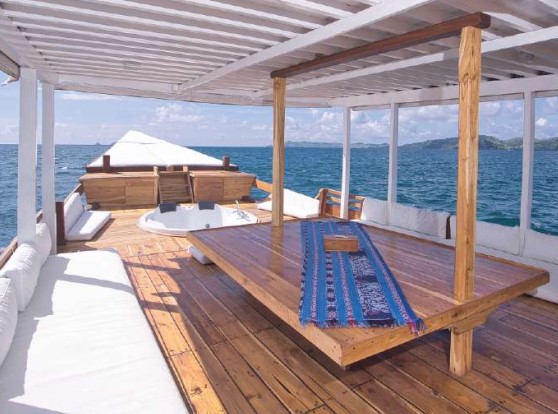
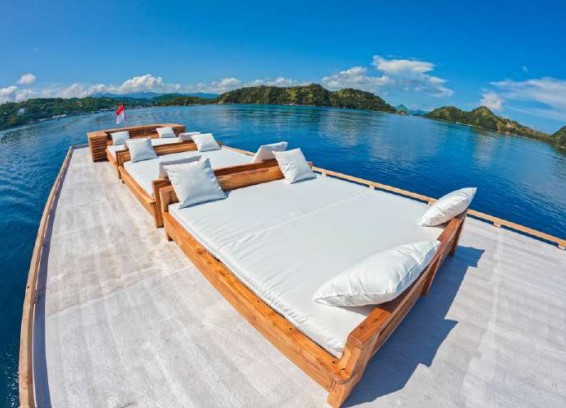
On calm nights guests regularly ask to sleep on the open deck, and the crew will set bedding up. Two conditions: the boat has to be at anchor rather than under way, and the captain has to be satisfied with the weather. It is a genuinely good experience at Kalong — you are under a mangrove-lined bay with almost no light pollution — and it is one of the few things a cruise offers that no hotel in Labuan Bajo can.
Frequently asked questions
Where does a Komodo cruise anchor at night?
On a standard 3D2N, night one is at Kalong after the flying-fox exodus, and night two is in a sheltered bay near the Manta Point cluster — most often Siaba Besar. Sebayur and Kanawa are the alternates when wind or swell makes the primary anchorage uncomfortable.
Is it noisy sleeping on a boat at anchor in Komodo?
At anchor it is quiet: the main engine is off and you hear the generator, the air conditioning and water against the hull. The noisy period is the overnight run from Kalong to Padar, roughly three to four hours, when the main engine is under load. Lower-deck cabins are closest to that noise but also the most stable.
Which cabin is quietest on Naturalia?
For engine noise, the upper-deck cabins — Azure, Coral and Breeze — are furthest from the machinery. For motion, the lower-deck cabins — Tide, Lagoon 1 and Lagoon 2 — sit closest to the waterline and move least. You are choosing between quiet and steady, not getting both.
Does the air conditioning run all night?
Yes. Naturalia carries a 31.3 kVA main generator with a second 31.3 kVA unit as backup, which is what allows air conditioning to run overnight at anchor rather than being shut down. A same-rating backup generator is not standard in this segment.
Why does the boat move at night?
Because the Padar sunrise cannot be reached from Kalong in the morning. The run is three to four hours, so it is done overnight or in the small hours. That single passage is why some guests take a seasickness tablet before bed on night one.
Can you sleep on deck?
Guests often do on calm nights, and the crew will set up bedding on the open deck on request. It is subject to the captain’s judgement on weather and to the boat being at anchor rather than under way, and it is not an option during the overnight passage.
Booking & enquiries
Naturalia Cruise is operated and marketed by Komodo Luxury (part of Juara Holding Group, working out of Labuan Bajo since 2015). Cabin availability, charter dates and written quotations go through the Komodo Luxury reservations desk: WhatsApp +62 811 3823 875 or sales@komodoluxury.com. Payment terms are published and unchanged: 50% deposit to hold the date, balance due 30 days before departure, full payment if you book inside 30 days, deposit non-refundable on cancellation.
Rates and tariffs on this page were last reviewed on 1 August 2026 and are quoted for the 2027 season. Vessel figures are the operator’s published specifications; national park tariffs are from PP No. 36 Tahun 2024. Always confirm the current rate in writing before transferring a deposit.